
October 1, 2025
Breathing in polluted air may speed up the progression of Alzheimer’s disease, according to a new report. The study found that people who live in areas with elevated levels of air pollutants had higher levels of toxic proteins characteristic of Alzheimer’s disease in their brains. They also had faster declines in memory and thinking skills than their peers who lived in neighborhoods with cleaner air.
“This study shows that air pollution doesn’t just increase the risk of dementia—it actually makes Alzheimer’s disease worse,” said Dr. Edward Lee, the study’s senior author and co-director of the University of Pennsylvania’s Institute on Aging. “As researchers continue to search for new treatments, it’s important to uncover all of the factors that contribute to the disease, including the influence of the environment in which they live.”
For the study, published in JAMA Neurology, researchers at the University of Pennsylvania’s Perelman School of Medicine looked at brain tissue obtained from autopsies of 602 men and women with Alzheimer’s disease. They ranged in age from 71 to 85 at the time of their death.
The researchers used data from satellites and local air quality monitors to assess pollution levels in the neighborhood where each person lived in the year preceding their death. They focused on exposure to tiny pollutant particles known as PM2.5, which are smaller than 2.5 micrometers in diameter, or 1/30th the width of a human hair.
These miniscule particles come from many sources, including car exhaust, wildfire smoke, power plants, construction site debris, and combustion from factories. They are easily inhaled into the lungs, where they enter the bloodstream and spread throughout the body, including the brain. High levels of PM2.5 pollutants have been linked to asthma and other respiratory disorders, as well as heart disease, strokes, Parkinson’s disease and other ailments.
The researchers found that compared to their peers who lived in less polluted areas, those who had lived in areas with high concentrations of PM2.5 air pollutants had greater brain accumulations of the telltale beta-amyloid plaques and tau tangles of Alzheimer’s disease. Examination of health and clinical records also revealed that they tended to have accelerated declines in memory, with greater impairment of speech, judgment and the ability to carry out personal care and other day-to-day activities.
The findings come on the heels of another recent report that analyzed data involving nearly 30 million men and women living in the United States, Europe, Asia and Australia. Researchers at the University of Cambridge pooled data from dozens of studies examining the effects of various air pollutants on brain health and found that three types of air pollutants in particular were linked to an increased risk of Alzheimer’s disease and other forms of dementia. In addition to PM2.5 particles, they included soot and nitrogen dioxide. Sources of these pollutants include vehicle exhaust (especially diesel exhaust), industrial smokestacks, wildfires, wood-burning fireplaces, gas stoves and heaters, even candles.
The researchers found that for every 10 micrograms per cubic meter of PM2.5, a person’s relative risk of dementia increased by 17 percent. The average levels of PM2.5 around roads in London in 2023, they note, was 10 micrograms per cubic meter. Similar increases of soot and nitrogen dioxide boosted dementia risk by 17 percent and 3 percent, respectively. The findings were published in The Lancet Planetary Health.
“Our work provides further evidence to support the observation that long-term exposure to outdoor air pollution is a risk factor for the onset of dementia in previously healthy adults,” said Dr. Haneeen Khreis, the study’s senor author. “Tackling air pollution can deliver long-term health, social, climate, and economic benefits. It can reduce the immense burden on patients, families, and caregivers, while easing pressure on overstretched healthcare systems.”
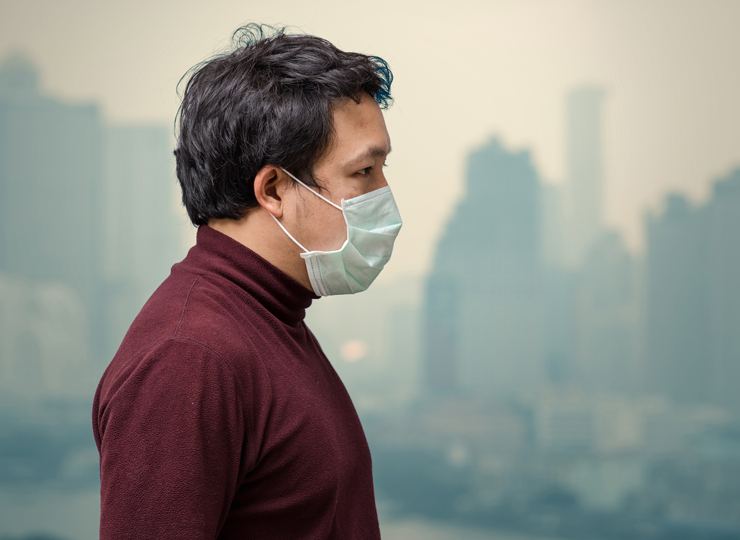
Experts advise a number of steps to limit exposure to air pollutants. Avoid exercising outdoors on days when pollution levels are high; move workouts indoors, to a gym, for example, or walk in a shopping mall. Wearing a high-quality face mask outdoors can also help when pollution is elevated. Limit the amount of time you spend near high-traffic areas, where vehicle exhaust fumes concentrate. Keep fuel-burning appliances and fireplaces in the home well maintained to minimize potentially dangerous emissions, and use exhaust fans in the kitchen when cooking. Ventilate your home regularly by opening windows when outdoor air quality is good. Purify indoor air with an air filter. And don’t smoke, especially in the house.
By ALZinfo.org, The Alzheimer’s Information Site. Reviewed by Eric Schmidt, Ph.D., Fisher Center for Alzheimer’s Research Foundation at The Rockefeller University.
Sources: Penn Medicine. Boram Kim, MD; Kaitlin Blam, BA: Holly Eiser, MD, PhD; et al: “Ambient Air Pollution and the Severity of Alzheimer Disease Neuropathology.” JAMA Neurology, September 8, 2025
Clare B. Best Rogowski, MPhil; Christiaan Bredell, MB, BChir; Yan Shi, MB, BChir; et al: “Long-term air pollution exposure and incident dementia: a systematic review and meta-analysis.” The Lancet Planetary Health, July 2025.